
Today’s Poem is a Tanka. (Syllable pattern 5-7-5-7-7).
Coffee nut latte?
Maybe that makes Cam perfect
For Em (or does it?)
Espressology’s a hit.
People want love and lattes.
Today’s Poem is a Tanka. (Syllable pattern 5-7-5-7-7).
Coffee nut latte?
Maybe that makes Cam perfect
For Em (or does it?)
Espressology’s a hit.
People want love and lattes.
This is a Kyrielle poem in response to Sharon Draper’s most recent book Panic (which I began and completed today).
DIAMOND
Though people tell of the danger,
Say “Never talk to a stranger”,
It was in public – light of day,
So She went with him anyway.
He was professionally dressed,
His intentions kept full at bay,
He portrayed a family-man (blessed)
So She went with him anyway.
She didn’t have nary a clue
Of the nasty things he would do,
Or the way the acts he’d display,
So She went with him anyway.
He claimed a daughter and a wife,
His evil plan not on display.
She wasn’t concerned for her life,
So She went with him anyway.

This is a “Found Poem” which is like a word-collage. I pulled some words and phrases from pages 98-100 of
The Smart Aleck’s Guide to American History, and arranged them into this:
Whig on a penny
Depression
Grew up to be
on the five-dollar bill.
Hated by some
Abraham Lincoln
Crippling anxiety
“Good Guys” and “Bad Guys” on both sides
States’ rights
Not all Southerners favored
Articles of Secession
Tariff disputes
Stovepipe Hat
End slavery

When I made the decision to post a poem each day of this month, it was with the intention of writing a different type of poem each day. I keep coming across the Blitz poem (invented by Robert Keim), and I felt the need to try it. It was challenging, but fun. Here’s what I came up with…
Man-All
Man o’ war
Man of steel
Steel boned corsets
Steel cut oats
Oats and whey
Oats and grains
Grains of sand
Grains of truth
Truth or dare
Truth be told
Told you twice
Told you so
So it goes
So you say
Say a prayer
Say my name
Name of names
Name that tune
Tune the piano
Tune in
In the closet
In the dark
Dark of night
Dark of day
Day of reckoning
Day-dream
Dream a dream
Dream and wish
Wish on a star
Wish me luck
Luck of the Irish
Luck be a lady
Lady and gent
Lady in waiting
Waiting on train
Waiting on a friend
Friend indeed
Friend in need
Need a break
Need a drink
Drink it up
Drink to that
That is all
That is enough
Enough to eat
Enough said
Said it all
Said it best
Best…
All…
Today’s poem is a Minute Poem, in which each stanza has four lines (8 syllables in the first line and four in the subsequent lines). This poem is in response to Paul Fleischman’s book Seedfolks.

Community, in brokenness-
Bad neighborhood,
Trashed vacant lot,
Hopeless and sad.
A Vietnamese girl, with seeds
Moves trash and digs.
Other neighbors
Hesitated.
Hispanic, Haitian, young and old,
Male and female,
Started to change-
Minds and gardens.
Silence and darkness split open
As trash is moved,
Hope is restored,
and beauty grows.

Bronx Masquerade by Nikki Grimes (Poetry Style: Joseph’s Star)
Ward,
Teacher-Man,
Changing our lives with
Open Mike Poetry Day.
Teenagers taking off masks
Real, recognizing-
New friendships.
Word.
Curveball: The Year I lost my Grip by Jordan Sonnenblick is Pete’s story. Pete is a freshman in high school, dealing with an injury to his arm that permanently impacts his ability to play his favorite sport – baseball. While Pete deals with teachers, girls, parents, and how to tell his best buddy AJ about his baseball issue, he is also hiding a secret. His grandfather is slowly losing his independence as Alzheimer’s takes over his memory and mind. Of course, all of these painful, awkward threads through the story are written Sonnenblick-style, meaning that you feel like you have a best friend with you, keeping you safe and laughing through the painful moments.
Pantoum Poem
Grandpa
Because memories matter,
Grandpa taught me to watch-
His love of photography,
His love of life.
Grandpa taught me to watch-
He gave me everything-
His love of life,
To see and to remember.
He gave me everything-
His love of photography-
To see and to remember,
Because memories matter.
 You Read to Me, I’ll Read to You by Mary Ann Hoberman
This book of “very short stories to read together”, illustrated by Michael Emberley, is really a book of poems. They are color-coded to show which parts I read, which parts you read, and which parts we read together. “I Hate My Hat” is one of my favorites!
 A Pocketful of Poems by Nikki Grimes
This poetry book alternates between free-verse and haiku. Each new topic is illustrated and has one of each type of poem. The illustrations by Javaka Steptoe combine paper cut-outs and three-dimensional objects.
 Science Verse by Jon Scieszka and Lane Smith
Scieszka and Smith explore (exploit?) various poems through scientific parodies. They cover the digestive system, evolution, black holes, food chains, matter and more. You will recognize the framework from many of the poems! Read “‘Twas the Night Before Anything” for their interpretation of the Big Bang theory and “Astronaut Stopping By a Planet on a Snowy Evening.” Fun stuff!
 My man Blue by Nikki Grimes
This picture book by Nikki Grimes, was illustrated by Jerome Lagarrigue in acrylics. While it is written in poetry form, and each poem can stand alone, the book really tells a story about a boy, Damon, who eventually accepts his mom’s “old friend.” Together, they face a class bully, anger, fear, and trust.
 Here in Harlem: poems in many voices by Walter Dean Myers
In this tribute to W. B. Yeats, Walter Dean Myers captures a vignette of Harlem. Through 54 poems, Myers introduces the different people that made up the community of his childhood home, and gives voice to each of them. Some of the people represented through poem include: a retiree, a nanny, some students, a janitor, a hairdresser, and a street vendor.
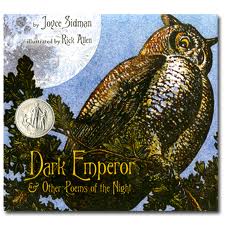 Dark emperor & other poems of the night by Joyce Sidman
This picture book by Joyce Sidman, and illustrated by Rick Allen is a picture book, a non-fiction book, and a poetry book all in one. Allen illustrated using “relief printing” which involves blocks of linoleum, ink, and in this case gouache (an intense watercolor). Sidman alternated between poetry that focuses on nature and a non-fiction explanation of the living things mentioned in the poem.
 Snow, snow: winter poems for children by Jane Yolen
Photography by Jane Yolen’s son, Jason Stemple, is highlighted in this book. Yolen wrote 13 poems to go along with, and inspired by, the photography. The style of each poem varies, but the topic is the same: they are all about snow.
 Sold by Patricia McCormick
Grades 9 and up
Lakshmi tells her story in verse, and it is an ugly, sad story of oppression. Lakshmi, at 13, is sold by her family in Nepal, and is brought to India’s “red light district.” When a man shows up for her services, and Lakshmi realizes what she is supposed to do, she tries to fight it. She understands, as other girls cope with this life in whatever way they can. Lakshmi is offered an out by someone she was told not to trust, but she is not really sure who to trust regardless. She has already seen what happens to a girl who tries to run away, and must choose from a variety of risks.
This excellent story, told in poetry, is eye-opening and based on real accounts of the trafficking that occurs in India.
 The Read-e-ologist